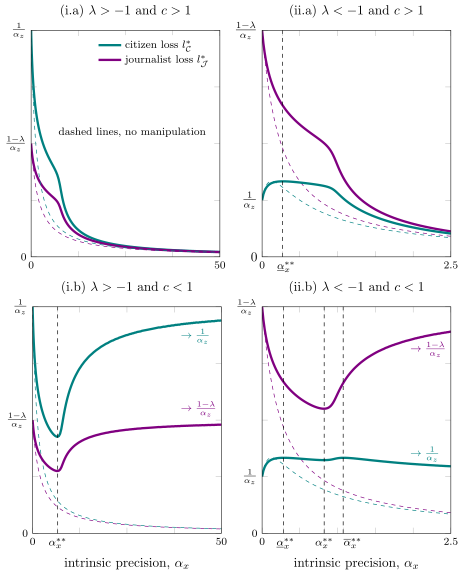
Citizens’ loss \(l_{\mathcal{C}}^*\) and journalists’ loss \(l_{\mathcal{J}}^*\) as functions of \(\alpha_x\) for \(c>1\) (top row) and \(c<1\) (bottom row) and for \(\lambda>-1\) (left column) and \(\lambda<-1\) (right column). If \(\lambda>-1\) both loss functions move in the same direction in response to \(\alpha_x\). If \(c>1\) both loss functions are strictly decreasing (top left). If \(c<1\) both loss functions are \(\cup\)-shaped with critical point \(\alpha_x^{**}\) (bottom left). If \(\lambda<-1\) the loss functions move in the same direction only between the critical points \(\underline{\alpha}_x^{**}\) and \(\overline{\alpha}_x^{**}\) (right column). If \(c<1\) the citizens’ loss asymptotes to \(1/\alpha_z\) and the journalists’ loss asymptotes to \((1-\lambda)/\alpha_z\). For the left column we use \(\lambda>0\) which implies that the journalists’ loss is less than the citizens’ loss. The colored dashed lines show the corresponding loss functions absent manipulation. If \(\lambda<-1\) then for \(\alpha_x\) sufficiently small the citizens are better off with manipulation.
In the paper: Figure 9. Citizens and journalists lose most when \(c\) is low and \(\alpha_x\) is high..