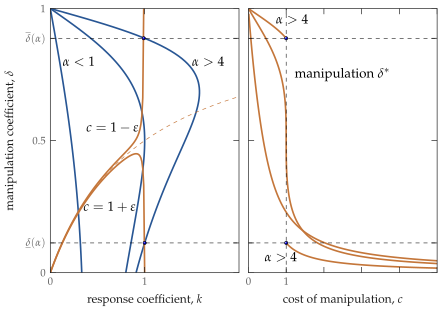
The left panel shows the citizens’ best response \(k(\delta;\alpha)\) for \(\alpha<1\), \(\alpha=4\) and \(\alpha>4\) (blue) and the politician’s best response \(\delta(k;c)\) for \(c=1-\varepsilon\), \(c=1\), and \(c=1+\varepsilon\) (red). For \(\alpha>4\), in the limit as \(c\rightarrow 1^-\) the equilibrium is at \(k^*=1,\delta^*=\overline{\delta}(\alpha)\) but in the limit as \(c\rightarrow 1^+\) the equilibrium is at \(k^*=1,\delta^*=\underline{\delta}(\alpha)\). For \(\alpha>4\) and \(c=1\) exactly both of these are equilibria because for this knife-edge special case the politician is indifferent between \(\underline{\delta}(\alpha)\) and \(\overline{\delta}(\alpha)\). The right panel shows the equilibrium manipulation \(\delta^*\) as a function of \(c\) for \(\alpha<1\), \(\alpha=4\) and \(\alpha>4\). For \(\alpha\leq 4\), the manipulation \(\delta^*\) is continuous in \(c\). But for \(\alpha>4\) the manipulation jumps discontinuously at \(c=1\). In the limit as \(\alpha\rightarrow\infty\) the boundaries \(\underline{\delta}(\alpha)\rightarrow 0^+\) and \(\overline{\delta}(\alpha)\rightarrow 1^+\) so that the manipulation jumps by the maximum possible amount, from \(\delta^*=0\) if \(c<1\) to \(\delta^*=1\) if \(c>1\).
In the paper: Discontinuity at \(c=1\) and jump in the amount of manipulation \(\delta^*\).