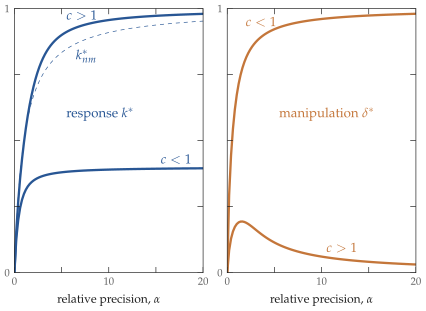
Citizens’ equilibrium response \(k^*\) (left panel) and politician’s equilibrium manipulation \(\delta^*\) (right panel) as functions of the relative precision \(\alpha\) for various levels of the costs of manipulation \(c\). The citizens’ \(k^*\) is increasing in \(\alpha\) and asymptotes to \(\min[c,1]\) as \(\alpha \rightarrow \infty\). If \(c<1\) then in equilibrium the politician’s marginal benefit of manipulation is increasing in \(k\) so \(\delta^*\) increases with \(k^*\) as \(\alpha\) rises and asymptotes to one as \(k^*\rightarrow c\). If \(c>1\) then for high enough \(\alpha\) we have \(k^*>\hat{k}(c)\) so that the politician’s marginal benefit of manipulation is decreasing in \(k\) so that \(\delta^*\) starts to decrease and asymptotes to zero as \(k^*\rightarrow 1\).
In the paper: Figure 2. Changes in the relative precision, \(\alpha\)..