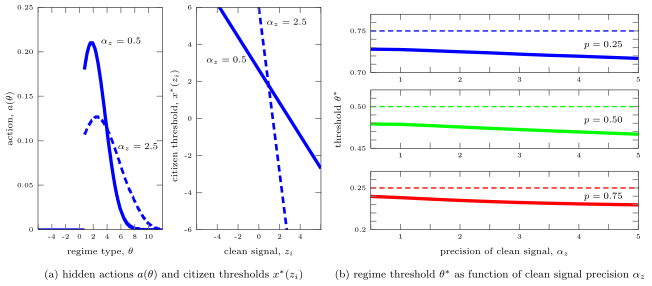
Panel (a) shows that as the precision \(\alpha_z\) of the clean signal information increases, regimes near \(\theta^*\) take smaller actions \(a(\theta)\) but \(\theta^*\) hardly changes. Citizens give more weight to their clean signal so \(x^{*}(z_i)\) is steeper, for low values of the clean signal \(z_i\) it takes a higher value of the manipulated signal \(x_i\) to induce participation in the attack. In this example the opportunity cost of participating is \(p=.25\). Panel (b) shows the regime threshold \(\theta^*\) as a function of the precision of the clean signal \(\alpha_z\). The regime still benefits from information manipulation in that \(\theta^*<\theta_{\text{MS}}^* = 1-p\). In all of these calculations, the manipulated signal has precision \(\alpha_x=.5\) and the cost function is \(C(a)=a^2/2\).
In the paper: Figure 7. Information manipulation still effective even though citizens have clean information..