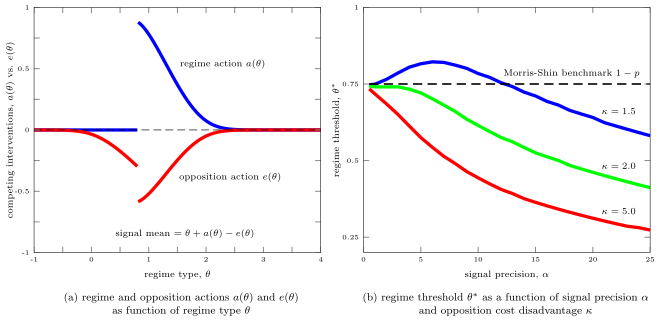
Panel (a) shows the regime’s and opposition’s actions \(a(\theta)\) and \(e(\theta)\) when there is a struggle over information. For clarity the opposition’s \(e(\theta)\) is plotted on a negative scale. For \(\theta<\theta^*\), only the opposition takes an action. For \(\theta\geq\theta^*\) the actions satisfy \(a(\theta)=\kappa e(\theta)\), where \(\kappa\) measures the costliness of the opposition’s action. In this example, \(\kappa=1.5\) and the opposition’s costs are greater than the regime’s. Panel (b) shows \(\theta^*\) as a function of the signal precision \(\alpha\) for various \(\kappa\). In these examples, the regime still benefits from information manipulation in that \(\theta^*< 1-p\) when \(\alpha\) is high enough. In these calculations, the opportunity cost is \(p=.25\) and the regime’s cost function is \(C(a)=a^2/2\) so that the opposition’s cost function is \(\kappa e^2/2\).
In the paper: Figure 5. Hidden actions and regime threshold when there is an opposition..