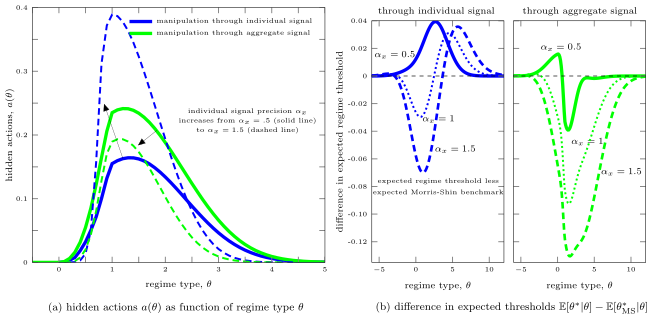
Panel (a) shows the regime’s hidden actions \(a(\theta)\) taken to maximize its expected payoff. Since there is aggregate uncertainty, for all \(\theta>0\) regimes take positive actions. The darker lines show the case of manipulation through individual signals, the lighter lines show the case of manipulation through the aggregate signal. The solid lines show low signal precisions \(\alpha_x=.5\) while the dashed lines show high signal precisions \(\alpha_x=1.5\). Panel (b) shows the difference between the average regime threshold and its Morris-Shin counterpart for the same specifications. For higher \(\alpha_x\), the average threshold tends to be lower than its Morris-Shin counterpart and the regime’s gain is relatively larger when the manipulation takes place through aggregate information. In all these examples, \(p=.25, \alpha_z=.5\) and the cost function is \(C(a)=a^2/2\).
In the paper: Figure 8. Manipulation through idiosyncratic vs. aggregate information..