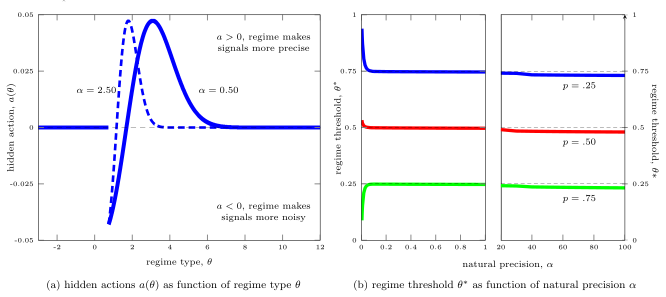
Panel (a) shows the regime’s actions to directly manipulate the number of signals \(n(a)\). For intermediate \(\theta\) it is optimal for \(a(\theta)<0\) so that the regime makes the signal more noisy than the natural precision, \(n(a(\theta))<\alpha\). For high \(\theta\) it is optimal for \(a(\theta)>0\) so that the regime clarifies its strength by making the signal more precise, \(n(a(\theta))>\alpha\). In this example the opportunity cost is \(p=.25\). Panel (b) shows \(\theta^*\) as a function of the \(\alpha\) for various \(p\). The regime benefits from information manipulation in that \(\theta^*< 1-p\) when \(\alpha\) is high enough. All calculations use the bounds \(\underline{n}=\alpha/2\), \(\overline{n}=3\alpha/2\) and cost function \(C(a)=a^2/2\).
In the paper: Figure 4. Hidden actions and threshold \(\theta^*\) when regime can control the number of signals..