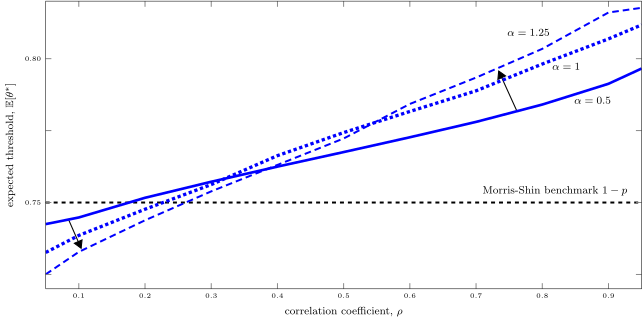
The expected regime threshold \(\mathbb{E}[\theta^*]\) as a function of the correlation coefficient \(\rho\) for various levels of the signal precision \(\alpha\). For fixed \(\alpha\), the expected regime threshold is increasing in \(\rho\), suggesting that increasing correlation works against the regime (it is more likely to be overthrown). At low levels of \(\rho\), an increase in \(\alpha\) reduces the expected regime threshold, as in the main model. At high levels of \(\rho\), an increase in \(\alpha\) increases the expected regime threshold, as in the perfect coordination model in Appendix B in the main text. In all these examples, \(p=.25\) and the cost function is \(C(a)=a^2/2\).
In the paper: Figure 9. For fixed signal precision \(\alpha\), regime disadvantaged by higher correlation \(\rho\)..